
Blog
Community Property vs Equitable Distribution: How Connecticut Divides a Business in Divorce
Connecticut is an equitable distribution state, not a community property state, which means a judge can assign all or part of a closely held business to either spouse regardless of whose name is on the stock. This guide explains how Connecticut values a business for divorce, when the valuation date falls, and how marketability discounts actually work in court.
Connecticut divorce courts have remarkably broad authority over a family business, and that authority surprises a lot of business owners who assume a company is untouchable because it is titled solely in their name. Understanding how Connecticut's property regime actually works, when the court sets the valuation date, and how discounts for marketability and control get applied can mean a swing of hundreds of thousands of dollars in a settlement. Our appraisers prepare Connecticut business valuation reports for divorce matters across the state, and this guide walks through the statute, the case law, and the valuation mechanics that matter most.
Connecticut Is Not a Community Property State
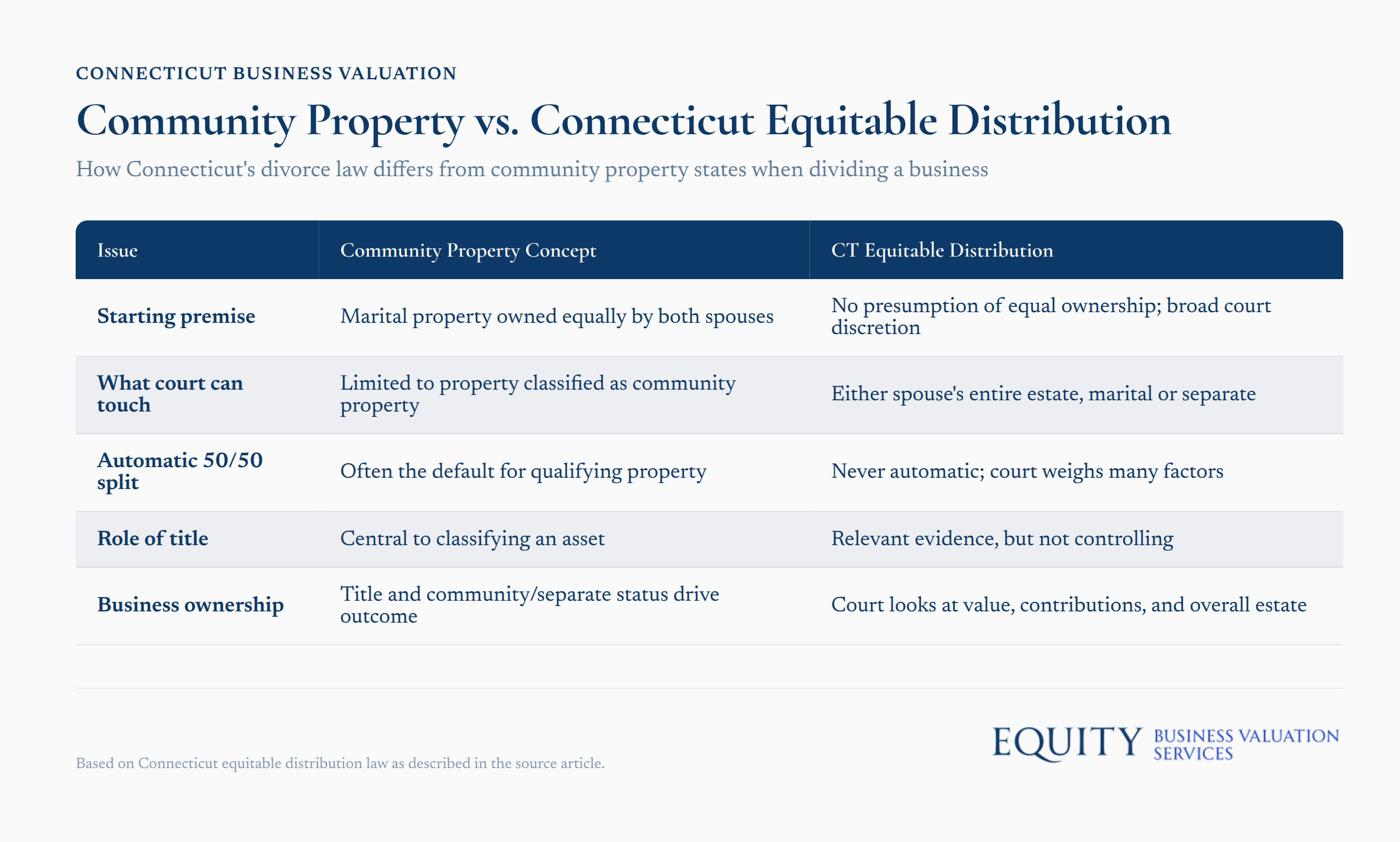
Connecticut is an equitable distribution state, not a community property state, and the distinction changes how a business gets treated in a divorce. A community property framework generally starts from the premise that property acquired during the marriage belongs equally to both spouses, with the main question being whether an asset counts as community property or separate property. Connecticut works differently: the court is not limited to dividing property that both spouses jointly own or that was acquired during the marriage.
Under Connecticut law, a judge may assign property belonging to either spouse, including assets one spouse owned long before the marriage or built entirely on their own. Title is relevant evidence, but it is not the deciding factor. That means a business formed by one spouse years before the wedding, held entirely in that spouse's name, can still be assigned (in whole or through an offsetting award) to the other spouse if the court finds that equitable.
| Issue | Community property concept | Connecticut equitable distribution |
|---|---|---|
| Starting premise | Marital property is generally treated as owned equally by both spouses | No starting premise of equal ownership; the court has broad discretion |
| What the court can touch | Usually limited to property classified as community property | The court may assign property from either spouse's entire estate |
| Automatic 50/50 split | Often the default for qualifying property | Never automatic; the court weighs numerous factors |
| Role of title | Central to classifying an asset | Relevant, but not controlling |
| Business ownership | Legal title and community/separate characterization drive the outcome | The court looks at value, contributions, and the overall estate |
"Equitable" is the operative word. It does not mean equal, and it does not mean the court splits a business 50/50 just because the marriage was long. It means the court is trying to reach a fair outcome given everything it knows about both spouses' circumstances.
How Connecticut Statute Governs Property Division in Divorce
Connecticut General Statutes section 46b-81 is the governing framework, and it gives the Superior Court sweeping power. The court may assign all or any part of either spouse's estate to the other spouse, transfer title to real property, and order property sold when a sale is necessary to carry out the judgment. The Connecticut statute on assignment of property requires the court to consider the nature and value of the property before making any award.
Before assigning property, the court must weigh a list of statutory factors, including:
- The length of the marriage
- The causes for the dissolution of the marriage
- Each spouse's age, health, station, and occupation
- Income, vocational skills, employability, and education
- Each spouse's estate, liabilities, and needs
- The opportunity of each spouse to acquire future capital assets and income
- Each spouse's contribution to the acquisition, preservation, or appreciation of the marital estate
That last factor matters enormously for a business owner. A spouse who never worked a day at the company can still have a legitimate claim to a share of its value if they supported the household, raised children, or otherwise enabled the owner-spouse to build the business.
When Is the Business Valued? The Date-of-Dissolution Rule
Connecticut courts generally value marital assets, including an ownership interest in a closely held business, as of the date the dissolution judgment enters rather than the date the case was filed or the date the spouses separated. Connecticut appellate authority addressing valuation timing in dissolution cases treats this as the default rule, and it has real teeth for a business that changes materially during a divorce.
A business can gain or lose significant value between filing and judgment. Revenue can climb, a major contract can be signed or lost, debt can be paid down, or the owner can pour profits back into growth rather than distributions. Because Connecticut locks in the valuation date at judgment rather than filing, a business owner cannot simply point to an older, lower number from the start of the case and expect the court to use it.
Courts do retain some discretion to look at a different date in unusual circumstances, such as when one spouse has deliberately manipulated the business's finances to distort its value before trial. That discretion is the exception, not the rule. For most cases, both sides should plan around a valuation that reflects the business as it exists close to the actual trial or settlement date.
Pro tip: If litigation is dragging on, update the valuation closer to trial rather than relying on figures prepared a year or more earlier. A stale valuation invites a credibility challenge from the other side.
Marketability and Lack-of-Control Discounts Aren't Automatic
In an open-market business sale, appraisers routinely apply discounts for lack of marketability and lack of control when valuing a minority, illiquid ownership interest. Connecticut courts treat those discounts as a question of fact for the trial judge, not as a mechanical adjustment that automatically applies just because an interest happens to be a minority stake.
Connecticut's widely cited Wendt v. Wendt line of authority illustrates the tension. The case addressed how to divide a closely held company founded during the marriage, and it highlighted that a court dividing marital property is not bound to replicate exactly how a willing buyer and willing seller would price the interest on the open market. A judge weighing how Connecticut courts have approached dividing a closely held business can decline to apply a steep discount if doing so would let the owner-spouse keep the operating business while shortchanging the other spouse's share of real, usable value.
That does not mean discounts never apply in a Connecticut divorce. It means the court examines whether the interest is genuinely noncontrolling and genuinely illiquid, and it balances that economic reality against fairness to the spouse who is walking away from the business. Factors a court typically considers alongside the statutory list (including each spouse's contribution to the business, as described in general Connecticut property division guidance) can push the final number up or down from what a textbook discount calculation would produce.
Watch out: Do not assume a 20% to 30% marketability discount will simply be accepted because it is standard in a commercial transaction. Our valuation team builds the supporting analysis to withstand that scrutiny, documenting exactly why a discount is or is not appropriate given the facts of the ownership interest.
A Worked Example: The Dollar Impact of a Marketability Discount
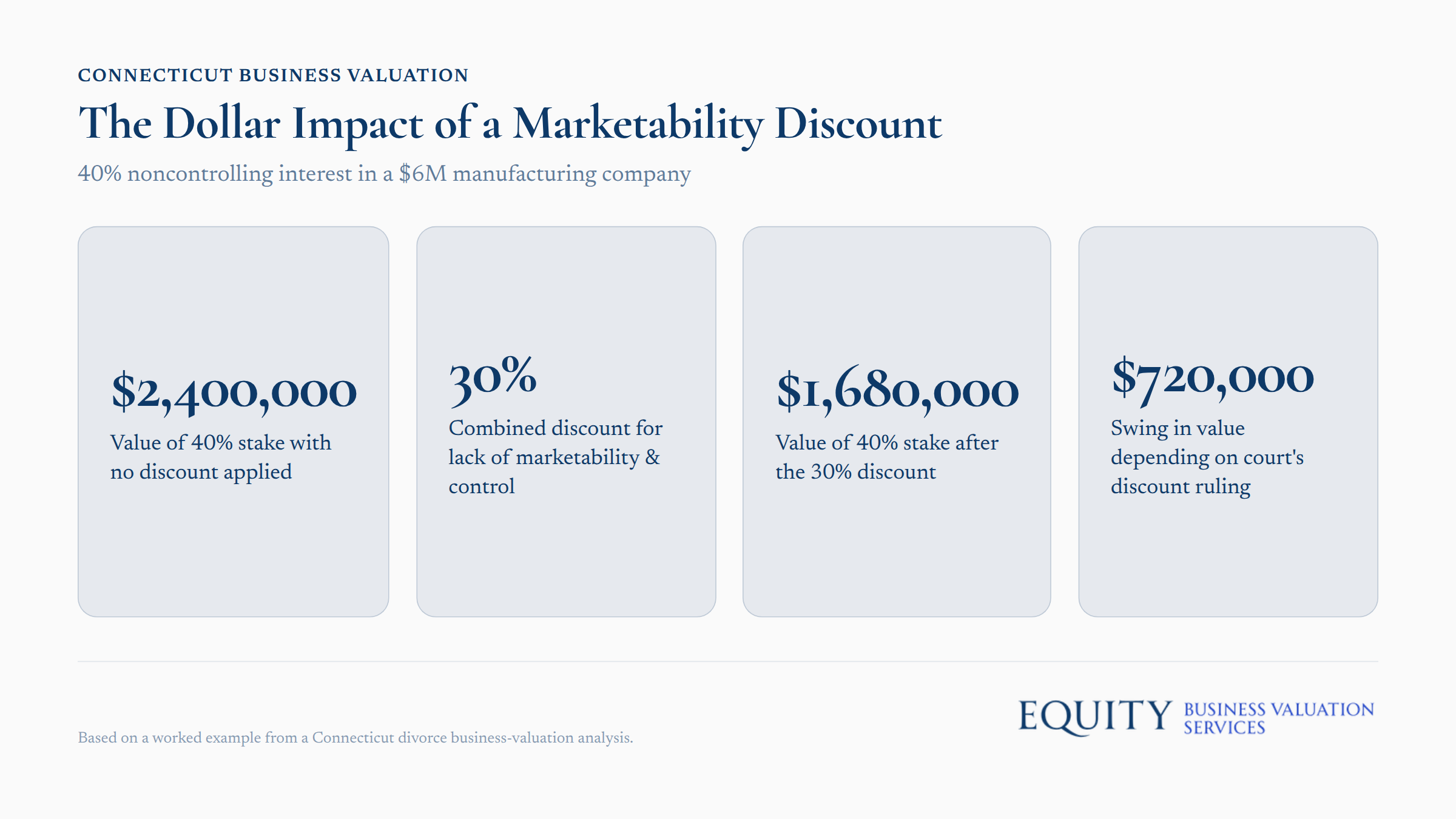
Example: A Connecticut business owner holds a 40% noncontrolling interest in a manufacturing company. Using the income approach, our appraisers conclude the company's total enterprise value is $6,000,000 as of the date of dissolution.
Without any discount, 40% of $6,000,000 comes to $2,400,000. Applying a 30% combined discount for lack of marketability and lack of control (a figure that would be defensible in a straightforward commercial sale of the same interest) brings that same 40% stake down to $1,680,000. That is a $720,000 swing in what one spouse might receive or be asked to offset, entirely driven by whether the court accepts the discount.
Because Connecticut treats that discount as a factual question rather than an automatic rule, the outcome depends heavily on the evidence presented: whether the interest really is illiquid, whether a sale is realistically anticipated, and whether applying the discount would leave the non-owner spouse with an unfairly small share of the marital estate.
What This Means for Business Owners Preparing for Divorce
A business owner going through a Connecticut divorce should assume the company is on the table, regardless of whose name is on the formation documents, and should start building a defensible valuation early rather than waiting for a settlement conference. Our guidance on how business value gets determined in a Connecticut divorce walks through the income, market, and asset approaches our valuation team applies depending on the type of business and the quality of its financial records.
Our appraisers hold credentials with organizations including the ASA and NACVA, and every divorce valuation is prepared consistent with recognized professional standards. For business valuation engagements, the fee is quoted as a fixed amount after we scope the assignment (never billed hourly), based on the complexity of the entity, the completeness of its financial records, and the depth of analysis the matter requires.
Key takeaway: Connecticut's equitable distribution statute gives the court real power to touch a business that one spouse built alone, the valuation date is generally locked to the day judgment enters, and marketability discounts are decided case by case rather than applied automatically. Getting ahead of all three issues with a well-documented valuation changes the leverage in a settlement.
If you or your client needs a defensible, court-ready valuation of a Connecticut business for a pending or anticipated divorce, request an appraisal and our valuation team will scope the assignment and timeline.
This article is provided for general informational purposes only and does not constitute legal, tax, or financial advice. Readers should consult a qualified attorney or CPA regarding their specific circumstances.